

A strong start for children who are deaf in Côte d'Ivoire
Monday 22 June
In late 2025, Kentalis International expanded its collaboration with its local Ivorian partner organization, Réseau Ivoirien pour la Promotion de l'Éducation Pour Tous (RIP-EPT), through the project 'A Strong Start for Deaf Children'. With this initiative, Kentalis International is the very first international organization to support parents of children with hearing loss in Ivory Coast.
Why this project?
In Ivory Coast, there is only one specialized school for the deaf in the entire country. At the same time, the World Health Organization estimates that 5% of the world’s population has some degree of hearing loss. That means that more than 527,000 children in Ivory Coast are hard of hearing or deaf. Research shows, however, that the percentage is much higher in countries with limited resources. Deaf children and their parents face enormous challenges: a lack of appropriate education, social exclusion, poverty, and stigma. Without intervention, an entire generation will be left behind.
On-site training sessions
In April and May 2026, Kentalis International, in collaboration with RIP-EPT, trained 10 social workers (both deaf and hearing) through the Parents Awareness Workshop (PAW) in Agboville, Ivory Coast. The PAW training sessions were led by project manager Marloes Williams-van Elswijk and experts Rachel Chomba (Zambia) and Ingeborg Snel. This marks the first time an international team of trainers has conducted a training program for Kentalis International. Rachel, who lost her hearing at age 14, is a powerful co-trainer for the PAW program due to her knowledge of the local context.
PAW is a training program that trains social workers to support hearing parents of deaf children. Social workers learn to encourage parents to connect with their deaf child and to break down negative perceptions and stigmas. During the first week of training, topics covered included: causes of hearing loss, myths and facts about hearing loss, social skills and positive parenting, sign language, language development and acquisition, Deaf culture, and human rights.
“PAW demonstrates the transformative power of awareness and access to information”
During the second week of training, the social workers visited the village of Lapo and a school in Agboville to talk with parents of deaf children about the topics covered during the first week of training. In Lapo, about 100 residents attended an informational session, about 40 of whom had hearing loss. These discussions were very productive. As trainer Rachel Chomba explains: “Although many expressed acceptance of the deaf members of the community as valued members of society, significant misconceptions about deafness and learning abilities persisted.” A recurring concern expressed by parents and community members was whether children born deaf can succeed in school. "There was little awareness that children born deaf can also learn, thrive academically, and reach their full potential when they receive the right support, including access to sign language and inclusive educational environments.”
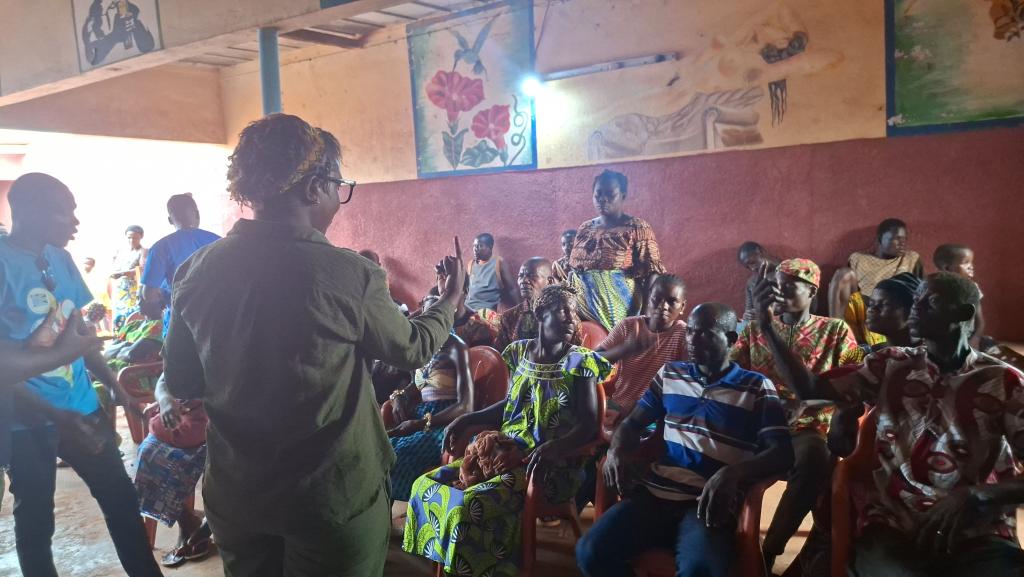
A large number of deaf children and adults in Lapo have never attended school due to these prevailing misconceptions and the lack of knowledge about deafness and education. As a result, the discussions with community members were very informative, meaningful, and motivating for parents and community members. Rachel explains: “As the discussions progressed, parents became increasingly aware of their deaf children’s rights and the importance of early access to education and language. Many participants indicated that they better understood how sign language communication can contribute to learning and social inclusion. The meetings also gave parents the opportunity to ask questions, challenge existing misconceptions, and gain practical knowledge about how to support their children at home and within their community.” The PAW is therefore an important piece of the puzzle for quality education.
The importance of a positive role model
For the Zambian expert Rachel, this was her first training session as an international Kentalis expert. Her role as a Deaf role model was particularly meaningful. She explains: “My presence as a trainer was a tangible example of what is possible when Deaf people have access to education, support services, and opportunities for personal development. I hope that my participation helped, at least a little, to break down prejudices and broaden perspectives regarding the potential of Deaf people."
“Thanks to these training programs, deaf children can be encouraged to reach their full potential”
Following the two on-site training sessions in April and May, the training phase of the project has come to an end. The social workers are now able to inform and empower parents of deaf children, which will have a greater impact on deaf children’s access to education.